How Radon Mitigation Works
The invisible product, made visible
Radon mitigation is strange to shop for. The problem has no smell, the product is mostly hidden in walls and attic, and success is a number on a lab report. No wonder homeowners squint at quotes. This guide exists to make the thing concrete.
Here’s the entire concept in one sentence: collect the soil gas underneath the home before it gets in, vent it above the roofline where it disperses harmlessly, and prove it worked with a follow-up test.
Everything else — the hardware, the acronyms, the design variations — is in service of that sentence. The gas was always going to rise out of the ground. A mitigation system just gives it a private exit so it stops using your basement as one.
Two pages pair well with this one. What the numbers mean explains the scale a system is judged against. And when you’re past the how-it-works stage and into the how-do-I-get-one stage, the mitigation service page covers assessment, design, and what an estimate involves.
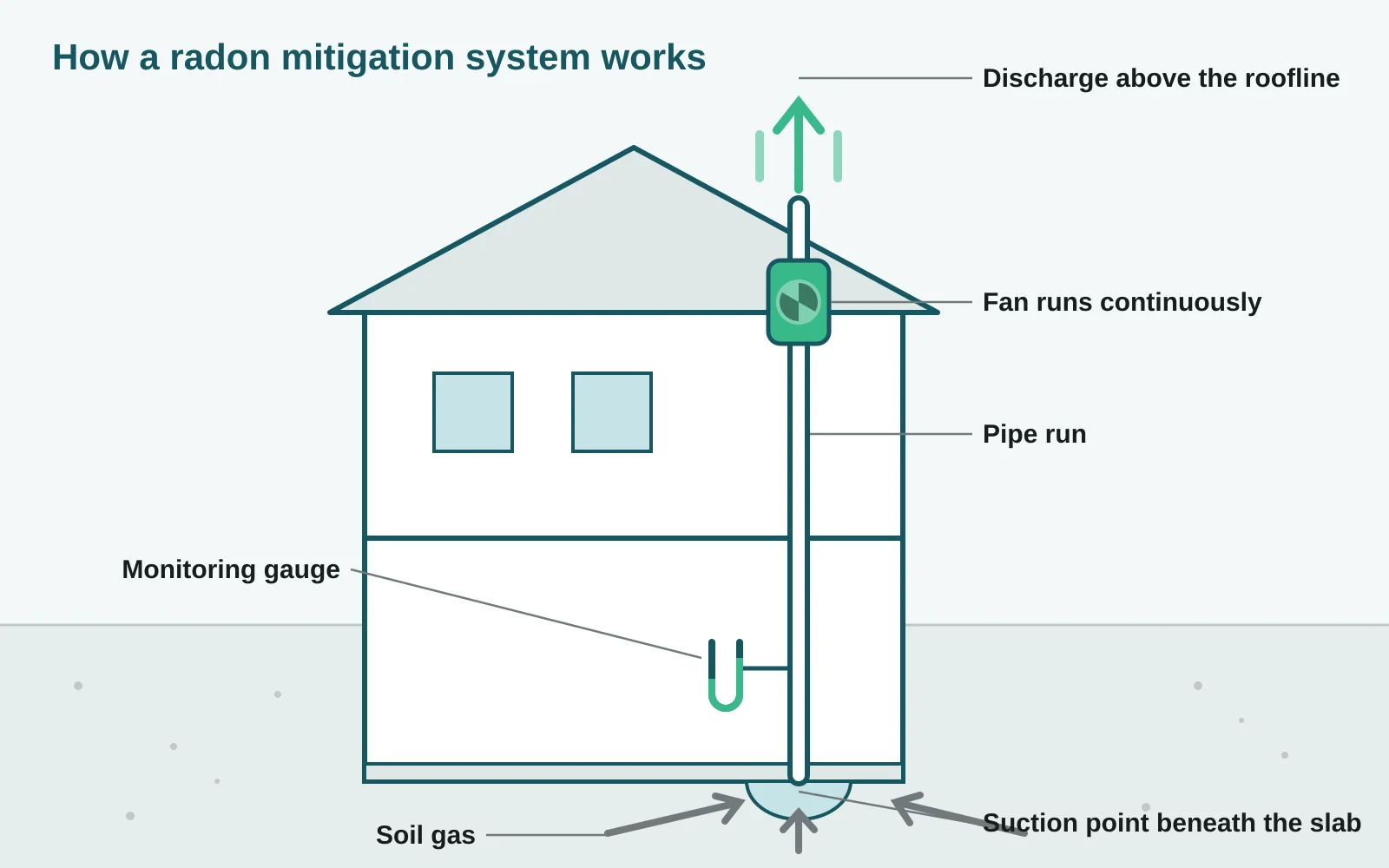
The parts, and the one job each does
The suction point. A hole cored through the concrete slab, with a small pit hollowed into the gravel or soil beneath. This is where the system grabs the gas: below the floor, before it enters. Most homes need one; big footprints or divided slabs sometimes take two. Homes with a sump pit sometimes use the pit itself, sealed under an airtight lid, since the drain tile already reaches the whole foundation. And homes over a crawlspace get a different version entirely: a heavy sealed membrane over the exposed dirt, with suction drawing from underneath the plastic.
The pipe run. Schedule-40 PVC, usually 3 or 4 inches, carrying the gas from the suction point to the roofline. Routing is the art: up through a closet or garage into the attic, or up an exterior wall. The pipe slopes so condensation drains back down instead of pooling.
The fan. The engine of the system, mounted in the attic or outside. It never goes in living space, so a pipe leak above the fan can’t push gas into the house. It runs 24 hours a day, every day, holding a modest vacuum under the slab. Radon fans are sized to the house; bigger is not automatically better.
The discharge. The pipe ends above the roof edge, away from windows, so the exhausted gas dilutes into open air instead of drifting back inside.
The gauge. A u-tube manometer on the pipe, holding colored fluid. Uneven fluid means suction; level fluid means the fan has stopped. It’s the system’s only dashboard.
Which combination fits a given house (slab, basement, crawlspace, some of each) is what the assessment decides. The parts are standard. The design isn’t.
Want this working in your home? Start with an estimate
Proof, not promises
A mitigation system has one success criterion, and it isn’t a tidy pipe run. It’s a lower number.
Systems are designed to bring the home below the EPA action level of 4 picocuries per liter, and the post-installation test is how that gets demonstrated. The test runs after the fan has been operating long enough to stabilize the house, typically at least a day, and produces a written result to set beside the original. High number before, low number after. That pairing is the product.
If the retest doesn’t clear the line, the system gets revisited: a stronger fan, an added suction point, a sealing pass. The point is that verification isn’t a courtesy call. It’s the step that separates mitigation from decoration. If a bid treats the retest as optional, that tells you something.
Afterward, ownership is light duty. Glance at the gauge a few times a year. Uneven fluid, all’s well. Retest every couple of years, since houses settle, fans age, and the meaning of the numbers doesn’t change. That’s the whole maintenance manual.
Three fixes that aren’t
Opening windows. Ventilation dilutes radon while the windows are open, and the level rebounds when they close. As a four-season strategy in South Dakota, it fails on both physics and January. It also wrecks any test you’re running at the time.
Air purifiers. HEPA filters and ionizers capture particles. Radon is a noble gas, and it sails through filter media untouched. A purifier can reduce radon’s decay products somewhat, but EPA guidance doesn’t treat filtration as radon mitigation, and neither should a homeowner reading a test report.
Sealing the cracks. The intuitive one. If gas comes through cracks, caulk the cracks. Except EPA guidance is blunt that sealing alone doesn’t reliably lower levels. Concrete is porous, new gaps open as houses move, and soil gas is patient. Sealing has a real role as a helper: it makes an active system’s suction field stronger. It just doesn’t hold the line by itself.
What the evidence supports is the boring answer: active mitigation, collected below the house, vented above it, verified by a test. The system in the diagram up top isn’t one option among many. It’s the one that shows its receipts.
Keep reading
-
Is my radon system working?
The owner's checkup — the gauge, the sounds, and when to retest.
Read more -
What the numbers mean
Picocuries, the action level, and the consider-action range, explained.
Read more -
The mitigation service
What an assessment-first install looks like on this side of the state.
Read more